Maximizing KDP Publishing Efficiency with 200 8.5x11 Trivia Questions Solutions
The landscape of self-publishing on Amazon Kindle Direct Publishing (KDP) has evolved from simple text-based novels to a diverse ecosystem of interactive content. Among the most lucrative and engaging niches are activity books, specifically those centered around trivia and general knowledge. For creators looking to enter or expand within this market, utilizing pre-formatted interiors like the 200 8.5x11 Trivia Questions Solutions package offers a strategic advantage. This resource is not merely a collection of questions; it is a foundational asset designed to streamline production while maintaining the flexibility required to create unique, high-value products for consumers, educators, and hobbyists.
Technical Specifications and File Management
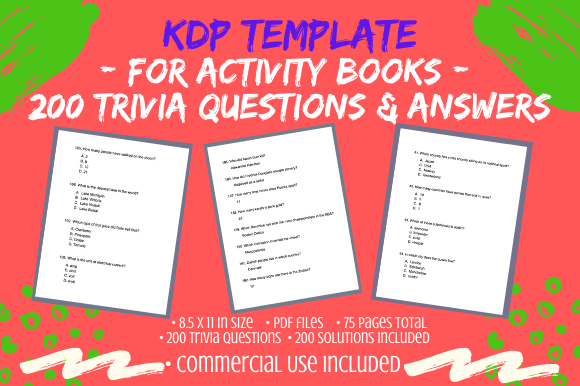
Understanding the technical parameters of digital assets is crucial for avoiding printing errors and ensuring a professional final product. The 200 8.5x11 Trivia Questions Solutions template adheres to strict industry standards that facilitate seamless uploading to KDP. The dimensions are set to the standard US Letter size of 8.5 x 11 inches, which remains the most popular format for activity books due to its ample writing space and readability.
A critical specification of this interior is the NO-bleed setting. In print design, bleed refers to artwork that extends beyond the trim edge of the page. By utilizing a no-bleed format, all content is safely contained within defined margins. This significantly reduces the risk of text being cut off during the trimming process and simplifies the cover creation process, as the cover file does not need to account for wrap-around bleed adjustments on the interior pages. The package includes two distinct PDF files: one containing the puzzle pages and another dedicated solely to solutions. This separation allows publishers to decide whether to include answers at the back of the book, in a separate section, or even as a downloadable bonus to drive email list signups.
The total page count for this specific interior is 75 pages, comprising 50 pages of trivia questions and 25 pages of corresponding solutions. This length is ideal for creating mid-sized activity books that offer substantial value without overwhelming the user or inflating printing costs. Before beginning any editing work, it is a best practice to create a duplicate copy of the original files. This preserves the master template for future projects and prevents accidental corruption of the source material during the customization process.
Strategic Customization to Ensure Content Uniqueness
One of the most significant challenges in the KDP activity book niche is the issue of duplicate content. Amazon’s algorithms prioritize unique customer experiences, and books with identical interiors may face visibility restrictions or rejection. Therefore, treating the 200 8.5x11 Trivia Questions Solutions as a raw canvas rather than a finished product is essential for long-term success. The ability to edit these PDFs using online converters or desktop software empowers creators to transform a standard template into a proprietary asset.
Diversifying Page Layouts and Visual Elements
To differentiate your publication, consider integrating visual elements that align with your specific sub-niche. While the base template provides the textual framework, adding relevant clip art, borders, or thematic icons can drastically alter the user experience. For example, a history-themed trivia book might feature vintage engravings, while a science-focused edition could utilize technical diagrams or nature photography. These additions break up text-heavy pages and increase perceived value.
Beyond aesthetics, structural modification is key. Publishers should feel encouraged to add, delete, or rearrange pages. Mixing trivia sections with other game types—such as word searches, crosswords, mazes, or sudoku—creates a "variety activity book" that appeals to a broader audience. Changing page titles, headers, and fonts further distances the final product from the original template. Even simple modifications, such as inserting motivational quotes between sections or adding a personal introduction, contribute to the uniqueness factor that search algorithms and customers reward.
Educational and Cognitive Applications
While often categorized as entertainment, trivia books serve significant functional roles in educational and therapeutic settings. Understanding these use cases helps in crafting better metadata and marketing copy. The structured format of 200 questions across 50 pages provides a consistent framework for cognitive engagement.
- Homeschooling Supplements: Educators can use these interiors as supplementary testing materials or fun review sessions. The no-bleed format makes it easy to print individual pages for classroom use without formatting issues.
- Senior Cognitive Therapy: Large print adaptations of trivia questions are frequently used in memory care facilities to stimulate recall and encourage social interaction among residents.
- ESL Language Learning: Trivia provides context-rich vocabulary practice. Teachers can customize the questions to focus on specific cultural references or language proficiency levels.
- Corporate Team Building: HR professionals and event planners often seek ready-made icebreaker activities. A customized trivia book can serve as a branded takeaway for retreats or training sessions.
By positioning the 200 8.5x11 Trivia Questions Solutions as a versatile tool rather than just a puzzle book, creators can tap into institutional buyers and educational markets that value utility over novelty.
Workflow Integration for Digital Product Creators
For entrepreneurs managing multiple KDP titles or digital download shops, efficiency is paramount. This template integrates smoothly into various production workflows. Because the files are delivered as digital PDFs, they are platform-agnostic and compatible with virtually all modern editing tools. Users preferring free solutions can utilize online PDF converters to merge, split, or annotate pages. Those with professional subscriptions can import the files into Adobe InDesign, Affinity Publisher, or Canva for more advanced layout manipulation.
The modular nature of the content supports a "mix and match" production strategy. A creator might develop a series of themed books by keeping the core trivia structure but swapping out the introductory pages, solution keys, and bonus activities. This approach allows for rapid scaling of a brand portfolio while maintaining consistent quality and formatting standards. Furthermore, because the cover is not included, designers have complete freedom to test different cover styles and keywords without being locked into a specific aesthetic dictated by the interior.
Navigating Platform Compliance and Quality Standards
Adherence to platform guidelines is non-negotiable for sustainable publishing. The explicit warning regarding duplicate content associated with the 200 8.5x11 Trivia Questions Solutions serves as an important reminder of Amazon’s quality thresholds. Simply uploading the unaltered PDF is unlikely to yield sustainable results and risks account penalties. Successful publishers view compliance as a creative constraint that drives better product development.
Quality assurance should extend beyond content uniqueness to physical usability. When customizing the no-bleed interior, always verify that new elements do not encroach upon the safe zone. Margins exist to ensure the book is comfortable to hold and read. Additionally, when adding external content like coloring pages or quotes, ensure the resolution matches the existing 300 DPI standard of the trivia pages to prevent pixelation in print. Testing the modified PDF through KDP’s previewer tool before publishing is a mandatory step to catch spacing errors or formatting glitches that might not be visible in standard PDF viewers.
Expanding Value Through Hybrid Content Models
The true potential of this 200-question database lies in its adaptability to hybrid content models. Modern activity books rarely succeed by offering only one type of engagement. The solutions pages, totaling 25 sheets, offer their own opportunities for enhancement. Rather than leaving them as plain text lists, consider transforming solution pages into educational resources. Adding brief explanations, historical context, or "did you know" facts next to answers turns a simple answer key into a secondary learning module.
This hybrid approach increases the word count and value proposition without requiring additional trivia generation. It also improves the book's stickiness, encouraging users to spend more time with each page. For digital sellers outside of KDP, the solutions file can be separated entirely and offered as a teacher’s edition or a premium upgrade. The flexibility to deconstruct and reassemble the 200 8.5x11 Trivia Questions Solutions enables creators to serve multiple market segments from a single source asset, maximizing return on investment while delivering tailored experiences to diverse audiences.
Considerations for Long-Term Asset Utilization
Investing in PLR (Private Label Rights) or commercial use templates requires a mindset of stewardship. The recommendation to maintain an untouched master copy of the 200 8.5x11 Trivia Questions Solutions is a fundamental data management practice. Over time, as you develop custom variations, having access to the clean source file prevents the degradation of quality that occurs when repeatedly editing previously modified PDFs. It also allows for quick pivots if market trends shift; you can return to the base and build in a new direction without undoing hours of previous customization.
Furthermore, tracking which modifications perform best is vital for iterative improvement. If a version mixed with coloring pages outsells a pure trivia version, future projects should lean into that hybrid model. The template serves as a controlled variable in your publishing experiments, allowing you to isolate the impact of design changes, keyword targeting, and niche selection. By treating this digital product as a dynamic component of a larger business strategy rather than a static commodity, creators can build a resilient and diversified catalog that withstands market fluctuations and platform updates.