Streamlining KDP Publishing with a Ready-Made Daily Goals Interior
The low-content publishing landscape on Amazon has evolved significantly. Gone are the days when simply uploading a generic lined notebook would generate consistent sales. Today’s successful publishers understand that specificity sells, and utility retains customers. Among the most enduring niches in this space is personal productivity, specifically through structured planning tools. Utilizing a pre-designed Daily Goals - KDP Interior allows creators to bypass the tedious design phase and focus entirely on keyword research, cover creation, and marketing strategy. This approach transforms what used to be a weeks-long design project into an immediate asset ready for deployment.
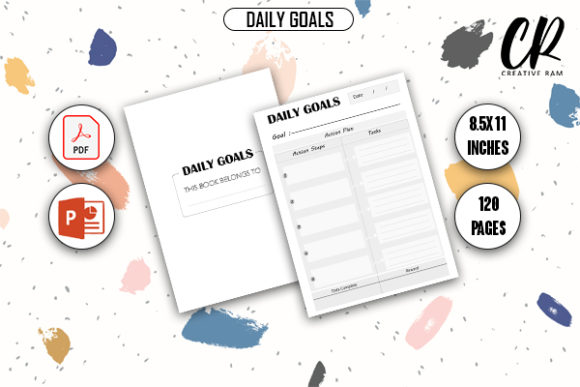
When evaluating digital assets for print-on-demand, technical precision is non-negotiable. A professionally structured interior must adhere strictly to platform guidelines to avoid rejection or poor customer reviews. The specific configuration of this resource includes standard 8.5″ x 11″ dimensions, which remains the gold standard for full-size planners and journals. With a total count of 120 pages, it offers substantial value to the end-user without pushing printing costs so high that profit margins evaporate. Furthermore, the inclusion of bleed settings ensures that any design elements extending to the edge of the page are trimmed correctly during manufacturing, eliminating the dreaded white border issue that plagues amateur submissions.
The Strategic Advantage of Editable Source Files
While a high-quality print-ready PDF is essential for immediate upload, the true long-term value lies in customization. Access to both PDF and PPTX source files fundamentally changes how a publisher can leverage this asset. PowerPoint might seem like an unconventional choice for book layout, but in the KDP ecosystem, it is a powerhouse for accessibility. Unlike Adobe InDesign, which requires expensive subscriptions and a steep learning curve, PowerPoint is familiar to most users. This lowers the barrier to entry for modifying the Daily Goals - KDP Interior to suit specific sub-niches.
Consider the practical applications of having editable source files. A generic daily goal tracker appeals to a broad audience, but a "Daily Goals for Nurses" or "Student Study Planner" targets a specific demographic with higher purchase intent. With the PPTX file, you can adjust headers, add niche-specific prompts, or modify the date fields in minutes rather than hours. This flexibility allows for rapid A/B testing of different concepts using the same foundational layout. You are not just buying a book interior; you are acquiring a scalable template system that supports portfolio diversification.
Balancing Page Count and Profit Margins
The decision to set this interior at exactly 120 pages is a calculated balance between perceived value and production cost. In the world of Amazon KDP, spine width matters. Books under 100 pages often lack a readable spine, making them difficult to identify on a physical shelf or in thumbnail previews. At 120 pages, this journal achieves enough thickness to support spine text, enhancing its professional appearance and discoverability.
From a royalty perspective, this page count sits in a sweet spot. It provides three to four months of daily tracking if used consistently, or a full year if used intermittently, justifying a mid-range price point. Simultaneously, it keeps fixed printing costs low enough to maintain healthy margins even after advertising spend. Publishers often make the mistake of creating 300-page behemoths that eat up all potential profit. This streamlined specification demonstrates an understanding of the unit economics inherent to print-on-demand business models.
Design Functionality and User Experience
A beautiful interior means nothing if it fails functionally. The best-selling productivity journals share common UX characteristics: ample writing space, clear hierarchy, and minimal friction. When reviewing the layout of a Daily Goals - KDP Interior, look for structures that encourage completion rather than overwhelm. Effective layouts typically include dedicated sections for top priorities, gratitude, water intake, and reflection, arranged in a way that guides the eye naturally across the page.
- Visual Hierarchy: Ensures the user knows exactly where to write first, reducing cognitive load during morning routines.
- White Space Management: Prevents the page from feeling cluttered, which is crucial for users who associate planning with stress relief.
- Consistency: Repeating the same structure for 120 pages builds habit formation, increasing the likelihood of positive reviews mentioning "ease of use."
- Bleed Safety Zones: Keeps critical text away from the trim line and gutter, ensuring no content is lost during binding.
These design elements are not merely aesthetic choices; they are retention mechanisms. Customers return to authors whose books actually work. By providing a layout that has been tested for usability, you reduce the risk of returns and negative feedback related to formatting issues. The included PDF serves as the final proof, guaranteeing that what you see on screen is exactly what will appear in print.
Integration into Modern Publishing Workflows
Speed to market is a critical metric in competitive niches. Traditional book formatting involves hiring a freelancer, waiting for revisions, checking proofs, and exporting multiple versions. This process can take weeks. Downloading a pre-formatted interior compresses this timeline to minutes. This efficiency is particularly valuable for trend-jacking or seasonal publishing. If you identify a rising search volume for "new year goal setting" in late November, having a compliant, ready-to-upload interior allows you to capitalize on the trend while others are still briefing designers.
Moreover, these assets integrate seamlessly with broader content strategies. The same structure used for a KDP paperback can be adapted into a digital download for Etsy, a lead magnet for an email list, or a bonus resource for an online course. Because the source files are included, cross-platform repurposing becomes straightforward. This multi-channel approach maximizes the ROI of a single asset acquisition, turning a simple book interior into a versatile component of a larger digital product ecosystem.
Evaluating Quality Before Upload
Even with instant downloads, due diligence is necessary. Before publishing any Daily Goals - KDP Interior, always verify the specifications against current KDP guidelines. Platform requirements occasionally change regarding margin sizes, bleed allowances, and color profiles. Open the PDF at 100% zoom to check text crispness and ensure lines are solid black rather than dark gray, which can print inconsistently. Test the PPTX file to confirm that master slides are properly linked, allowing for global changes across all 120 pages without manual editing.
It is also wise to order a physical proof copy before launching ads. Digital screens can be deceiving; paper texture affects ink absorption, and binding margins can feel tighter in hand than on a monitor. Verifying the tactile experience ensures that the final product meets customer expectations. This step bridges the gap between digital convenience and physical quality assurance. When the technical foundation is solid, marketing efforts yield better results because the product delivers on its promise. Ultimately, the goal is to build a sustainable publishing business where efficiency does not come at the expense of excellence.