Integrating Dice Sudoku - 180 Puzzles Solutions V2 into Commercial and Educational Print Projects
The landscape of self-publishing and educational resource creation has shifted significantly toward modular content assets. For creators developing activity books, cognitive training materials, or classroom supplements, the bottleneck is rarely the concept but rather the production of high-quality, formatted interior pages. Dice Sudoku - 180 Puzzles Solutions V2 addresses this specific friction point by providing a comprehensive library of logic puzzles in both pre-formatted PDF and individual PNG formats. This dual-format approach allows professionals, educators, and hobbyists to bypass the tedious puzzle generation phase and focus entirely on curation, branding, and distribution.
Strategic Value of Dual-Format Asset Delivery
Most puzzle resources force a choice between convenience and flexibility. A single merged PDF is excellent for immediate printing but useless for a designer who needs to place a single puzzle onto a branded worksheet. Conversely, a folder of loose images requires hours of manual layout work to create a publishable book. This resource package eliminates that compromise by delivering two distinct asset types tailored to different stages of the production workflow.
The Ready-to-Upload PDF Workflow
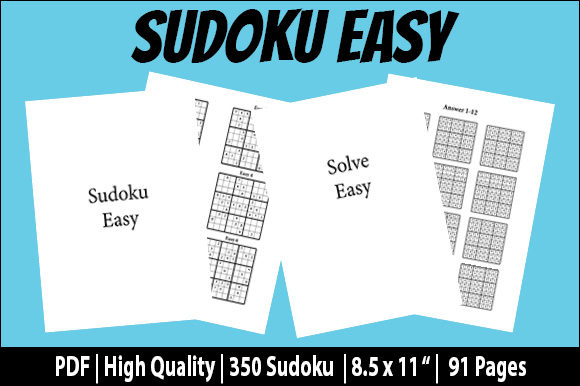
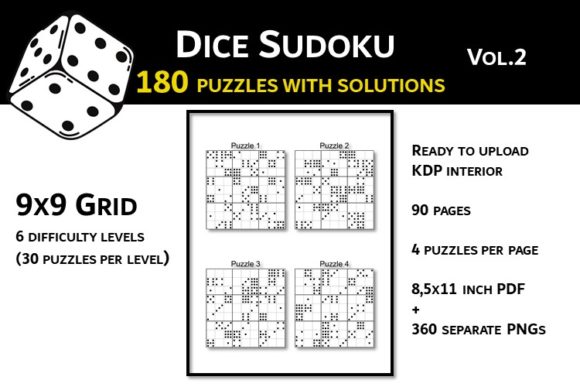
For Amazon KDP authors and print-on-demand entrepreneurs, speed to market is often a critical metric. The included 90-page PDF serves as a complete interior file formatted specifically for 8.5″ x 11″ paper. With four puzzles per page and a corresponding four answers per page layout, this document adheres to standard industry trim sizes and margin requirements. This format is ideal for:
- Rapid Prototyping: Testing market demand for dice sudoku niches without investing weeks in formatting.
- Supplemental Content: Adding value to existing journals or planners by inserting a ready-made puzzle section.
- Direct Printing: Creating physical copies for personal use, senior centers, or library programs immediately upon download.
Modular PNG Assets for Custom Design
The inclusion of 360 separate PNG files (180 puzzles and 180 solutions) transforms this product from a simple book into a versatile design toolkit. Each image is a high-resolution element that can be dragged and dropped into Adobe InDesign, Canva, Affinity Publisher, or PowerPoint. This granularity supports complex projects such as:
- Mixed-Media Activity Books: Combining dice sudoku with mazes, word searches, and coloring pages within a unified layout.
- Digital Products: Creating interactive PDFs or tablet-friendly worksheets where only one puzzle appears per screen.
- Marketing Materials: Using individual puzzles as lead magnets, social media engagement posts, or newsletter content to drive traffic to larger products.
- Custom Branding: Placing puzzles onto pre-designed templates that include specific headers, footers, logos, or instructional text unique to your brand identity.
Cognitive Applications Across Difficulty Spectrums
Unlike traditional number-based Sudoku, Dice Sudoku utilizes visual pattern recognition alongside logical deduction. This distinction makes it an exceptionally valuable tool for diverse audiences, ranging from early learners to seniors maintaining cognitive acuity. The collection is segmented into six distinct difficulty levels, with 30 puzzles allocated to each tier. Understanding these tiers is essential for effectively deploying the content.
Early Engagement: Very Easy and Easy Levels
The entry-level puzzles serve as an introduction to the mechanics of visual logic. For educators and parents, these are not merely pastimes but foundational exercises in pattern matching and spatial reasoning. Because the stimuli are graphical rather than numerical, they remove language and math barriers, making them accessible to pre-readers, ESL students, or individuals with dyscalculia. In a therapeutic setting, these levels provide achievable wins that build confidence before progressing to more complex challenges.
Skill Maintenance: Normal and Hard Levels
The middle tiers represent the core experience for general consumers and hobbyists. These puzzles require sustained attention and the application of elimination strategies similar to classic Sudoku but translated into a visual medium. For activity book creators targeting adults or teens, this range provides the "flow state" necessary for relaxation and stress relief. In corporate wellness programs or team-building workshops, these levels offer a balanced challenge that is engaging without being frustrating.
Advanced Cognitive Training: Very Hard and Extreme Levels
The upper echelons of difficulty are designed for enthusiasts and cognitive training applications. These puzzles demand advanced working memory and multi-step forward planning. Researchers and clinicians focusing on executive function may find these extreme variations useful for assessing or training mental stamina. For commercial publishers, including this top tier adds perceived value and longevity to the product, ensuring that users do not exhaust the content's utility too quickly.
Technical Specifications and Layout Optimization
Successful integration of puzzle content requires adherence to strict technical standards to ensure print quality and user experience. The assets in Dice Sudoku - 180 Puzzles Solutions V2 are engineered with professional publishing specifications in mind.
Print-Ready Dimensions and Resolution
All assets are optimized for 8.5″ x 11″ paper, the industry standard for trade paperback activity books. The 4-up layout (four puzzles per page) maximizes paper efficiency while maintaining adequate white space for user annotations. When using the individual PNG files, creators should maintain the original aspect ratio to prevent distortion of the dice graphics. The resolution is sufficient for crisp printing at standard viewing distances, ensuring that the pip details on the dice remain sharp even when scaled moderately for custom layouts.
Solution Key Organization
A frequently overlooked aspect of puzzle book design is the answer key. Poorly organized solutions frustrate users and increase support requests. This package solves that issue through consistent pagination. The solution pages mirror the puzzle pages, with four answers per page arranged in the same grid position as their corresponding puzzles. This intuitive alignment reduces cognitive load during verification. For creators building custom books, the separate solution PNGs allow for flexible placement, such as grouping all answers at the back of the book or placing them upside-down at the bottom of each page.
Commercial Licensing and Content Scalability
For business owners and self-publishers, the primary consideration beyond quality is licensing and scalability. This asset pack is structured to support commercial volume without repetitive content fatigue. With 180 unique puzzles, a creator can produce multiple distinct products from a single source. For example, one could extract the 60 easiest puzzles for a "Kids' Visual Logic" book, use the middle 60 for a "Daily Brain Break" office journal, and reserve the hardest 60 for a "Mastermind Challenge" edition.
Furthermore, the non-numerical nature of Dice Sudoku provides inherent internationalization advantages. Unlike language-heavy word puzzles or culturally specific trivia, visual logic transcends linguistic borders. Creators can sell the same PDF or customized versions in multiple marketplaces without translation costs. The dice imagery is universally recognized, making this content type highly scalable across global platforms like Amazon KDP, Etsy, and Teachers Pay Teachers.
Implementation Considerations for Educators and Therapists
Beyond commercial publishing, the practical application of these assets in educational and clinical settings warrants specific attention. The separation of puzzles and solutions allows facilitators to control the learning environment precisely. Teachers can distribute only the puzzle PNGs via digital learning management systems while retaining solution keys for grading or guided review sessions.
In occupational therapy or rehabilitation contexts, the ability to isolate specific difficulty levels is crucial. A therapist working on cognitive recovery might start a patient exclusively on "Very Easy" PNGs printed on cardstock, gradually introducing "Easy" puzzles as milestones are met. The clean, uncluttered aesthetic of the dice graphics minimizes sensory overload, which is particularly important for neurodivergent users or those recovering from traumatic brain injury. By having 30 puzzles per level, practitioners have sufficient material for longitudinal tracking without repeating the exact same stimuli, which could lead to rote memorization rather than genuine skill development.
Enhancing User Experience Through Curation
While the raw assets are comprehensive, the end-user experience depends heavily on how creators implement them. Professionals should consider adding contextual framing to maximize engagement. For instance, when using the PNG files in a custom activity book, adding brief strategy tips or visual tutorials on the first few pages can significantly reduce abandonment rates for new players. The dice mechanic, while intuitive, benefits from explicit instruction regarding row, column, and subgrid constraints.
Additionally, creators should leverage the separate solution files to enhance perceived value. Rather than simply appending answers at the end, consider creating a "Solution Walkthrough" section for selected hard or extreme puzzles. Using the individual PNGs, you can annotate specific steps or highlight patterns directly on the puzzle image. This transforms a static answer key into an educational resource, differentiating your product from generic puzzle compilations and demonstrating expertise in the niche.
The versatility of Dice Sudoku - 180 Puzzles Solutions V2 lies in its recognition that modern content creation is not monolithic. Whether the goal is a rapid-release KDP title, a bespoke classroom worksheet, a therapeutic assessment tool, or a mixed-media activity book, the combination of pre-formatted efficiency and modular flexibility provides a robust foundation. By understanding the distinct advantages of each format and the cognitive implications of each difficulty tier, professionals can deploy these assets strategically to meet specific audience needs while maintaining high production standards.